
Stealth-mode robotics startup
Turning a Robotics Concept into a Technical Roadmap
A discovery engagement that turned an early-stage mobile care robot concept into a credible technical roadmap — before development began.
- Client
- Undisclosed
- Sector
- Care & assistive robotics
- Stage
- Early-stage concept
- Services
- Discovery & Strategy · Robotics Systems Engineering
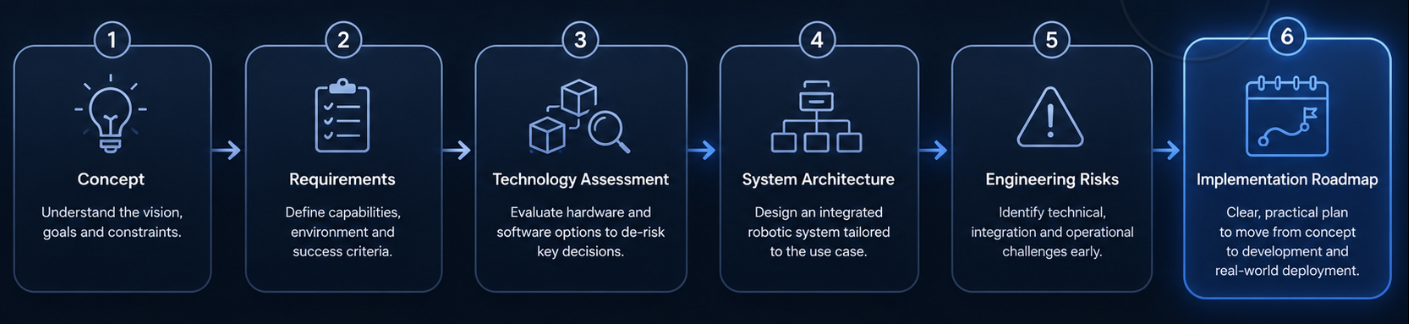
A robotics startup operating in stealth approached Code & Motion with an early-stage concept for a mobile robotic platform intended to operate in a demanding, human-centred care environment.
At this stage, the concept had significant potential, but there were also important engineering questions to answer.
What would the system need to operate reliably in the real world? Which technologies were mature enough to build upon? What would need to be engineered from scratch? And what challenges could prevent the concept from becoming a viable product?
Our role was to help answer those questions before significant development work began.
The Challenge
The proposed system combined several complex areas of robotics into a single platform.
It would need to operate autonomously within an indoor environment, interact with people, perceive and manipulate objects, integrate with existing systems and operate safely around staff and patients.
Rather than approaching each capability independently, we looked at the problem as a complete robotic system.
This meant considering:
- Mobile robotics and autonomous navigation
- Robotic manipulation
- Perception and sensing
- Real-time computing
- Human-robot interaction
- Software and systems integration
- Safety
- Deployment and ongoing operation
The objective wasn't to produce a final engineering specification. It was to establish whether the concept had a realistic technical path forward and identify the major challenges that would need to be addressed.
Discovery Before Development
The first stage was an assessment of commercially available robotics technology.
We broke the proposed platform down into its major subsystems and evaluated potential off-the-shelf solutions against the requirements of the overall system.
This included considering:
Mobility
Could a commercially available mobile platform provide the manoeuvrability, stability and positioning required for the intended environment?
Manipulation
Could available robotic arms and end effectors provide sufficient reach, payload and control for the expected physical interactions?
Perception
What combination of cameras, ranging sensors and other perception technologies could support navigation and interaction?
Compute
Which capabilities needed to run directly on the robot, and which could potentially be handled by more powerful local or remote compute?
Integration
How could the individual components be brought together into a coherent robotic platform?
The aim was not simply to identify the most capable component in each category. We considered maturity, software support, integration effort, cost, safety and suitability for the wider system.
This provided a practical starting point for further development while reducing the risk of designing around immature or unsuitable technology.
Looking Beyond the Prototype
A technically impressive robot is only useful if it can operate effectively in the environment for which it was designed.
We therefore looked beyond the robot itself and considered what would be required to introduce a system like this into a real facility.
Environment
The physical environment can have a major impact on robotic performance.
We considered factors such as accessibility, narrow spaces, obstacles, object placement, interaction points and the suitability of the environment for robotic operation.
This helped identify where future deployment might require either engineering solutions or changes to the environment itself.
Navigation & Mapping
Autonomous operation would require the robot to understand and navigate its surroundings reliably.
We considered the mapping and localisation process, including how an initial facility map could be created, how important locations could be represented and how changes to the environment could be managed over time.
The assessment also considered techniques that could improve localisation reliability in areas where precise positioning would be important.
Connectivity & Infrastructure
Robots operating in real facilities are dependent on more than their own hardware.
Reliable network connectivity, appropriate infrastructure and collaboration with the facility's IT team would all be important considerations.
We explored how networking could be incorporated into the deployment process while considering reliability, security, maintainability and the practical constraints of existing infrastructure.
Software Integration
The robot would ultimately need to fit into existing operational workflows rather than operate as an isolated system.
We identified the need to consider integrations with existing facility systems, as well as the workflows and escalation rules that would determine when the robot should act autonomously and when a human should take over.
This is a key distinction between demonstrating a robotic capability and deploying a useful robotic product.
Safety
Operating around people introduces another layer of engineering complexity.
We considered the need for appropriate safety systems, emergency stopping, safe operating procedures, staff awareness and clear responses to unexpected behaviour.
Safety therefore needed to be considered as part of the system architecture rather than treated as a final-stage addition.
Operations & Maintenance
We also considered what happens after deployment.
Who is responsible for the robot during operation? What happens if it fails part-way through a task? How are software updates managed? What routine checks are required? When does a fault require the robot to be removed from service?
These questions helped move the discussion beyond a prototype and towards the practical realities of operating a robotic system over its lifetime.
The Outcome
The discovery work gave the founding team a clearer technical understanding of the path from concept to development.
Rather than simply demonstrating that the technology was theoretically possible, the work established:
A clearer system architecture
Breaking the concept into the major technical subsystems required to develop it.
A practical starting point
Identifying commercially available technologies that could form the basis of an initial system.
A clearer view of engineering risk
Highlighting the technical, environmental, integration and safety challenges that would need to be addressed.
A route towards deployment
Considering the infrastructure, workflows, operational processes and maintenance requirements that would ultimately surround the robot.
From Concept to Informed Decision
For an early-stage robotics company, knowing what not to build can be just as valuable as knowing what to build.
By investigating the concept before development began, Code & Motion helped the team replace some of the uncertainty surrounding the idea with a clearer understanding of the engineering involved.
The resulting technical work provided a stronger foundation for the company as it progressed the concept and developed its proposition for investors.
The Value of Discovery
Robotics projects can become expensive very quickly when technical assumptions are left untested.
A focused discovery phase can help answer the important questions early:
- Is the concept technically realistic?
- What could the first system look like?
- Which technologies can be bought rather than built?
- Where are the biggest engineering risks?
- What will be required to move from a prototype into the real world?
Code & Motion helps turn early-stage robotics concepts into informed technical decisions — before significant development resources are committed.
Exploring a Robotics Idea?
Let's discuss how we can help turn your concept into an informed technical decision.